Showing posts with label Games. Show all posts

Monday, January 5, 2015

Using Games For Formative Assessment


From SmartBrief and Forbes:

There are educators who use game-based learning to conduct regular formative assessments, according to a recent study funded by the Bill & Melinda Gates Foundation. Researchers surveyed 488 educators in grades K-12 and found that 57% use digital games in their classrooms, while 34% reported using them for weekly formative assessments.

http://www.forbes.com/sites/jordanshapiro/2014/12/18/study-shows-video-games-impact-on-face-to-face-teaching/

Let us know what you think! Connect with us @C_LaCross

Monday, September 22, 2014

Incorporating Game-Based Learning


We all enjoy doing some games in class now and then. Sometimes these are just used to fill time though. However, Michele Huppert, in the blog post linked below challenges educators to incorporate educational games in the classroom.

http://smartblogs.com/education/2014/08/25/integrating-game-based-learning-into-the-school-year/?utm_source=brief

  • What types of quality educational games and game-like activities can we do in the language classroom? 
  •  Are games something purely for the lower level courses?


Let us know what you think! Connect with us @C_LaCross

Friday, December 27, 2013

Spanish: El Baul de los Recuerdos - Game for the Imperfect


Hi everyone,

I would like to share this fun game to practice the Spanish Imperfect. You would need to prepare the material before class but your students will most likely love it!

El baul de los recuerdos

Let us know what you think! Connect with us @C_LaCross

Tuesday, October 29, 2013

Halloween Body

This is an easy Halloween themed lesson that uses a game similar to battleship  but simpler.

This is designed to practice body parts students normally don't learn. You can alter it to practice easier body parts, or to cover more of the body (ankles, wrists, etc.)

Each of your students will need a dice or a coin and a piece of paper. Give them the following directions:


Roll a dice 5 times and put the results in the spaces below.
Cheeks: ___ Eyebrows: ___ Eyelids: ___  Lips:___ Nostrils: ___
Now that you know how many of each your monster will have go ahead and draw a picture of your monster (add as many arms, legs, tongues, etc. as you like!)

If they don't have a dice have them flip a coin 5 times for each body part and put the number of heads+1 they flipped as the number (or change the chart so it starts with zero and have none be an option).

Once they've draw their monster have them fill out this chart
Once they've done this (like the example below) have them find a partner (but be sure not to show their monster or chart to the partner.

Now the students can start playing. They should take turns asking one another, "Does your monster have three eyes?" or "Does your monster have 4 eyelids" etc. The point of the game is to guess the other students monster.

Have fun and Happy Halloween!

I'd love to hear if you use this activity (or something different). You can tweet me @ESLCarissa, join my group on facebook or just check out my regular blog.

Wednesday, October 23, 2013

News: How one teachers uses games in the classroom


In a recent blog post, educator Matthew Farber discusses how he uses digital games and board games developed by the Institute of Play's Mission Lab to engage his sixth- and seventh-grade students in class. For instance, he uses the nondigital debate game "Socratic Smackdown" for class discussions. "Games enable my students to discover different ways of solving problems, which is more like life and less like standardized tests," according to Farber. 

You can view his blog post here:
http://www.edutopia.org/blog/game-based-learning-in-practice-matthew-farber

In what ways do you incorporate games into your language classroom? Can games be effective in higher level courses or are they only useful for beginners? Do you have a favorite game that the students always enjoy? Have you used any digital language learning games?

Let us know what you think! Connect with us @C_LaCross

Tuesday, June 18, 2013

Spanish: Great games for children


Chris here again with a great link for some Spanish games for children via @SpanishPlaygrd!:


Let us know what you think! Connect with us @C_LaCross

Thursday, January 24, 2013

Balloons? Yes please!


Who doesn't love balloons? Well, my sister is actually afraid of them (Random fact: globophobia is the fear of balloons) 

Other than my sister though balloons are fun! They make us think of parties and other get-togethers. How can you bring the excitement of balloons into the class?

Games
  • My college courses often play a review game where they blow up balloons and then divide the class into two groups. The students each take turns coming to the class and popping balloons different randomly selected ways. "Pop the balloon with your butt, against someone else, with your chest, with your hands, etc" Once they did that, they could run to the board and answer a question. If they answer the question correctly their team gets a point. As a teacher I thought it was a waste of time (all the balloon popping really doesn't have much of an educational aspect), but my students loved it! They got SO involved in the class I think it was worth it. I added another aspect, if anyone spoke any language other than English their team lost a 1 point.
  • There's a great game on reviewing categories with balloons here Essentially balloons are treated as whiteboards and students have to fill them with different vocabulary words. There's a similar game involving balloons without helium here (it is essentially a volleyball game).
Visuals
  • If you are reading from a book or having them listen to a tape script where students may be confused about who says what use balloons to distinguish. Write the names on the different colored balloons and hold the appropriate balloon up when the appropriate person is talking.
  • Learning emotions? Draw faces on balloons! Students LOVE it :-)
  • Add some fun to group work! When checking multiple choice quizzes have students review their answers in a group and then hold up a colored balloon to indicate their choice (A-red, B-yellow, C-orange, D-white)

Monday, December 31, 2012

ESL/EFL: Great Games for Your ESL Classroom


Hello, here is a small list of fun games you can use in your language classes. The description is for ESL but you can adapt these for any language. I hope you find them useful! 7 Games for Your ESL Classroom. Do you use any other games in your classroom? What works well?

Let us know what you think! Connect with us @C_LaCross

Wednesday, December 12, 2012

Review Game! Have your students review with a snow fight!

I remember in high school one teacher, who I can't remember exactly...either an English or History teacher, had us push the desk and chairs to each side of the class making two "trenches." We balled up old quizzes, tests, and homework, and for about five minutes threw the paper balls back and forth at each other. I can't remember the point of the lesson, but I do remember it was lots of fun! So when Lee Adams told me about a review activity he played involving balled up paper I was hooked. He thinks he got it from The Accelerated Learning Handbook.

  1. Basically each student gets a piece of scratch paper (be it homework that you accidentally photocopied with a typo and it thus is trash or any other one side free page). I often tell them they can use old math or chemistry assignments to get more of a cathartic relief. 
  2. On the paper they legibly write a question in English from something that we covered (or that I have told them will be on the test). 
  3. They each ball up the piece of paper and wait.
  4. Once everyone is ready set a timer for 30 seconds (if you have an IWB or projector I suggest the bomb countdown). 
  5. Let chaos break out as the students have 30 seconds to pelt the "snowballs" at one another (and probably the teacher too).
  6. When the timer goes off they have to grab the "snowball" closest to them. 
  7. The teacher takes turns calling on volunteers to read their question and come up with the answer.
 As always, I can think of a few alternatives

  • Make the snowballs yourself. Now this is one less step for the students, but if you have specific things you want covered it may be better. Hand out the paper as though it were a one page quiz and then tell the students to ball it up! That will make them happy :-)
  • Make it a competition. My teenagers LOVE competing against one another. So do like my high school teacher did. Divide the class into two groups. At the end if they answer their review question right, their team gets 10 points. If they don't get it right, let their team help them out and if as a team they are correct they get 5 points. (Let the other team steal after that for 5 points i f you wish)
  • Code it! Give each student a different color paper (or save the planet and use scratch paper that you've put different symbols onto). Tell them that a blue (or smiley face) paper is vocabulary, a green (or star) is relative clauses, a red (or circle) is short story, etc. That way they are still writing the questions, but you can promise a variety of categories at least. 
  • Use it for new vocabulary or grammar. Have them write a sentence with a blank for the voab word (or draw a picture of the vocabulary word) OR have them write an example of the new grammar and the student has to guess the grammar (or vice versa, they write the grammar topic and the student would need to give a sample sentence).
So there we go, a great way to get the blood pumping in your class!

If you are looking for another easy, no prep and fun game like Flyswatter.

Would you use this in your class? Would you change it first? What other ideas does it give you?

Sunday, November 25, 2012

News: Families use songs and games for earlier language learning


A group of parents and their young children have started meeting regularly to learn to speak Spanish and English through songs and games. Some experts say infants who are exposed to multiple languages have better language acquisition later in life. You can read more about this group via the Greenfield Daily Reporter article linked below:

Monday, May 14, 2012

Why use games in teaching English?

Monday, April 23, 2012

Spanish: Juego con Reflexivos, Se recĆ­proca e Impersonal


¡Hola! AcĆ” va un juego que se puede hacer dividiendo la clase en grupos!

Spanish Jeopardy Game: Reflexivos, se Impersonal, etc. (PPT)

Monday, February 6, 2012

Games: Jeopardy!


Hi all, this is Yumiko. Today I would like to share a useful game template with you. Every teacher knows that playing a game is the most exciting time in a foreign language classroom. Here is a Powerpoint template for Jeopardy (I used 25Q&A Jeopardy Template), and now you can hold the famous American quiz show in your classroom. I used it last time when I taught superlatives in Japanese. Some of the questions I made were "What is the highest mountain in Japan?" and "What is the oldest sport in Japan?" You can use the game either as a practice or as a review. Enjoy!!

Wednesday, October 19, 2011

Spanish: Futuro y Condicional

Hello everyone, Claudia here,

I wanted to share with you a picture I made for my students to learn the 12 irregular verbs in the future and the conditional tenses in Spanish. I drew a clock and for every hour on the clock I set an irregular verb so that students can learn them and remember them if they draw the clock.

You can also make the clock hands move so you can play with it. Just spin the hands and students will have to conjugate the verb they land on. you can alternate person and number.

Teachers often use the "12 Apostles" of the Christian church as a mnemonic device with these verbs but I prefer using something everyone can relate to; since not everybody belongs to the same religion.

I hope you find this helpful and fun! Enjoy!

Saturday, September 24, 2011

Brock Dubbels : Ways to Teach with Games and Shared Simulations

You can use games in your classroom for inquiry and training!


Brock Dubbels : Ways to Teach with Games and Shared Simulations

Sunday, September 11, 2011

Go Fish (in Japanese)

This is a really fun game to memorize Hiragana (Japanese letters). The rule is same as regular Go fish. Prepare at least 1/2 sets of Hiragana flash cards (25 cards) per 4 students.

1. Work in a group of 4. (make sure to include at least 1 person who knows the rule)
2. Each member gets 5 cards. (Do not show them to others.) The rest of the cards should be piled on your desk.
3. Before starting the game, if you already have matching cards, put them in the pile.

4. A-san asks B-san, “(hiragana) ga arimasuka?” if B-san has it, B-san has to give it to A-san, saying “hai arimasu” Then, A-san puts the matching cards in the pile.
5. If B-san does not have it, say “iie arimasen”, then says “Go fish” to A-san, and A-san gets one card from the pile.
6. The first person who doesn't gave any cards wins!

Friday, February 11, 2011

Surrealist games

The Surrealists used these games to explore the role of chance and the unconscious in artistic creations. But they're also a fun way to work on parts of speech and Q&A in the FL classroom:

Exquisite corpse:
  • Each person receives a piece of paper and a pencil.
  • As a class, decide on a sentence structure (for example: Article/Adjective/Noun/Verb/ Adjective/Noun)
  • In the first round, each person writes a word fitting the outlined sentence structure.
  • Fold the paper over to conceal the written word and pass it to the next person.
  • The next person writes a word (fitting the outlined structure), conceals it, and then passes the paper to the next person.
  • Repeat this procedure until the structure is complete.
  • When a round of sentences has been completed, the student who wrote the last word should open the paper and read the complete sentence.

New Definitions: Work with a partner. One player writes down a simple "What is (noun)?" question on a sheet of paper, and then folds it over so the next person cannot see the question. The second player writes an answer on the same sheet of paper, without seeing the question (be as creative as you want). The paper is unfolded to reveal the result. Remarkable “facts” will emerge.

Some examples: Q: What is happiness? A: Going the extra mile Q: What is music? A: Clouds floating by.

Monday, October 4, 2010

Spanish: Vocabulary Game

Hello all, Julie here. Remember the scene in the movie Inglorious Basterds when a group of German soldiers is in a bar playing a name game? I used this idea in my Spanish class last week as a communicative activity and as a way to get students 'thinking' and speaking in Spanish. The next chapter that we studied was going to be on nationality vocabulary so this game was a good way to incorporate speaking skills, culture, and vocabulary.

This game could be used with introductory levels as well and could be a good game for practicing question formation. Just think of some famous celebrities from the Hispanic, German, Japanese, etc. world and write one name on each small piece of paper. I used Rafael Nadal, Penelope Cruz, Fidel Castro, Pedro Almodovar, Don Quijote, Sancho Panza, Jennifer Lopez, Cheech Marin...etc. Then, put students in groups of 2 and give one student the name of the famous person, but do not let them look. The student with the paper sticks or holds the name card to their forehead. (The other student sees the name.) The students with the name card does not know who they are and have to ask questions such as, "Am I a male or female? Am I famous? Am I a politician? Am I young or old...etc. Students can keep track of how many names they guess.

I usually play this game for about 15-20 min and find myself constantly giving each group a new name so have many name cards ready. At the end of the game one of my students, who is usually reticent to speak, screamed out, "I'm Rafael Nadal! Oh my gosh, I love him!"

Comments welcome!

Wednesday, August 25, 2010

Babbleship

I came up with this game to give my linguistics students a way to practise pronouncing phonetic symbols without context clues. It seems as though when you teach symbols simply by having students read transcribed words, students use the symbols that look like regular letters to read what the word is and don't attend to the sounds made by the symbols they don't know. This game forces them to think about what sounds each symbol makes.

The game is played the same way as Battleship. If you're not familiar with the rules of Battleship, you have five boats in your personal fleet:

The patrol boat takes up 2 spaces (XX)
The destroyer takes up 3 spaces (XXX)
The submarine takes up 3 spaces (XXX)
The battleship takes up 4 spaces (XXXX)
The carrier takes up 5 spaces (XXXXX)

You play in teams of two. Each of you has a 10x10 grid that represents your ocean. You can place your five ships anywhere in your ocean, as long as they go horizontally or vertically. You're not supposed to let your partner see your ocean.

When you're finished, you end up with a grid that looks something like this:

12345678910
AXX
B
CX
DX
EX
FXXXX
GX
HX
IX
JXXXXX


Your partner then tries to guess where your ships are by calling out the letter and number of a square in the grid. If your partner called out A1, you would say "patrol boat, hit." If your partner called out B1, you would say "miss." Then you would get a turn to hunt for one of your partner's ships. You take turns guessing one at a time whether either of you gets a hit or not. When your partner has guessed all the spaces for a given ship, you say, for example, "You sank my patrol boat." The object of the game is for one person to be the first to sink all five ships in the other person's fleet.

The way that I make this a phonetics game is by replacing the letters A-J with phonetic symbols for consonants and the numbers 1-10 with phonetic symbols for vowels. Instead of calling out "A1," players have to pronounce the syllable that would be made by that consonant and vowel symbol together. So, if instead of A I have [h] and instead of 1 I have [u], players have to pronounce [hu] in order to guess that their opponent's ship is hidden in square A1.

I make up several different versions of the game cards so that people in the class don't just listen to what groups around them are doing to get the answer, and so that people can play again if they finish early. In order to make the cards, you need to start with an 11x11 table; once you have filled in whatever symbols you want across the top and along the side, copy-paste that table a second time so that you will have two identical game cards for a pair of students to play with. (You should be able to fit two tables on one sheet of paper, which is a convenient way to make sure you've got a match for every game card before you photocopy multiples; then you can just cut the sheets in half). Give students a few minutes to draw their ships into their ocean, and then circulate around the room to help make sure they're pronouncing the unusual symbols correctly!

Spanish: A jugar "stop"!

Hi everybody, Claudia here,

I would like to share a really fun game your students will definitely enjoy! The game has different names through out Latin America: stop, basta, tuti fruti, bachillerato stop.

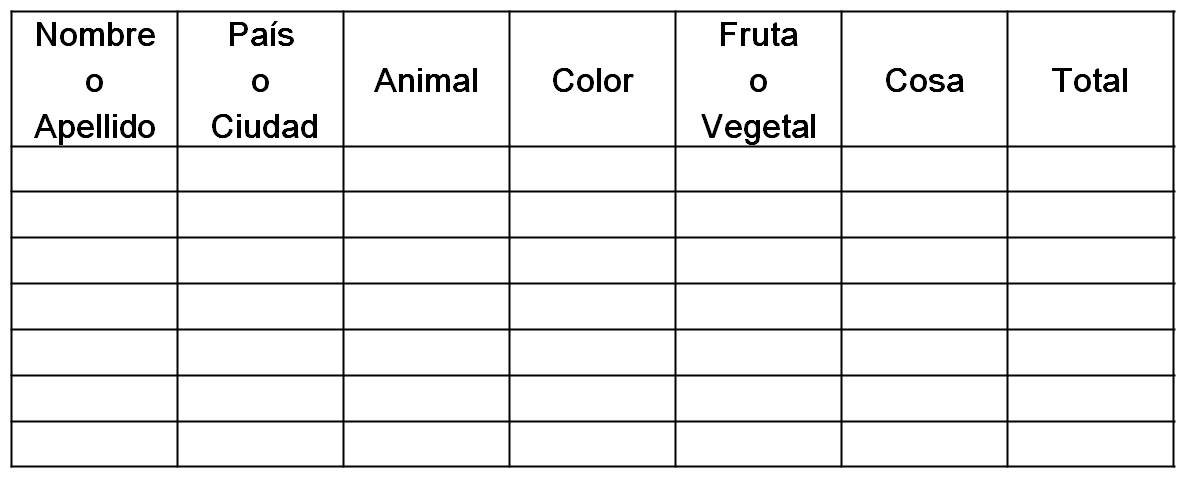
The idea is to have a person, the teacher, draw random letters with out looking. When you call out the letter, the students need to fill out a table with different categories with words that start with that letter. Each category is worth 1 point and you add all the points in the row and write it in the total box. The tricky part is that it is a race! the first person who finishes has to say "stop" and everybody else has to stop writing. Then everybody gets to read their answers starting with the student who finished first. If someone is missing a category or wrote a wrong word they don't get that point. You can draw however many letters you wish and end the game by adding the total column to see who won the game.

You can choose to play this in small groups of 4 or do it as a whole class. I attached 2 different tables as examples so you can see how you can adapt the game for your class depending on the level of your students and the focus of the course. For example, you could use different categories such as authors, artists, books, etc. For the country category I always say that they can use a city as long as it isn't in the US.

I hope you like this game and that you use it in your classes! Please let me know how it works for you!


Followers

Teaching Topics

A1 (1) AAFLT (1) AATG (15) About LTT (1) Abroadways (1) Accusative Prepositions (1) Achievement Gap (1) ACTA (1) ACTFL (18) Activities (1) Adjectives (3) Advanced Learners (11) Advanced/intermediate Learners (4) Adventskalender (2) Advertisements on TV (1) AEPE (1) Afghanistan (1) African-American English (1) AITLA (1) Alabama Immigration (1) Algeria (1) All Languages (11) Alphabet (2) Alsace (1) Amazing Race (3) Anglicisms (3) Animals (1) Animoto (1) App-Gap (2) Applied Linguistics (1) Apps (11) Aprendizaje Movil (1) Arabic (4) Argentina (1) Argentine Culture (1) Armored Penguin (1) articulation (2) Assessment (5) Asterix (1) Audacity (1) Audio (1) Augsburg (1) Australia (1) Avatar Software (1) Aventa (1) AZCALL (1) Baalbek (1) Bairisch (4) Ballet (1) Ballinstadt Museum (1) Balloons (1) Battleship (3) Bayerischer Rundfunk (1) Bayern (7) BBC (1) Beginners (4) Belgium (2) Berlin (5) Berlin Wall (2) Berufe (1) Bier (1) Bilingual Education (3) Bilingualism (11) Bing (1) Bingo (4) Birthdays (1) Blancanieves (1) Blended Learning (3) blog (2) Blog Carnival (1) Board Races (1) Body Parts (2) Bolivia (1) Brazil (1) Budget Cuts (24) BundeslƤnder (1) Bunny (1) Business (5) BYOD (1) Cafe Press (1) CALL (1) Call for Papers (7) Caperucita Roja (1) Carissa (18) Carissa Peck (19) Carnaval (1) Carnival (2) CELE (1) Cell Phones (1) Cenicienta (1) Cheating (2) Chicago (1) Child Foreign Language Acquisition (2) China (28) Chinese (56) Chinese Culture (1) Chinese Grammar (9) Chinese Music (1) Chinese Video (1) Chinese Vocabulary (8) Christmas (1) Chronicle of Higher Education (1) CIEFE (1) Cities (1) CIVTRALFE (1) Class Size (1) Classroom Management (1) CLEAR (1) Clipart (1) Cloud Computing (2) Cloze Activities (1) CLTA (1) Club Digital (1) Cognates (2) Collaboration (2) Colombia (3) Colors (4) Commands (1) Commas (1) Commercials (5) Common Core (1) Condicional Simple (1) Conditional (1) Conferences (279) Confucius Institutes (1) Conjugation (7) Conjunctions (1) Content Language Integrated Learning (1) Conversaçãos (4) Conversaciones (8) Conversation (3) Cooking (1) Corpus linguistics (1) Counterfeit goods (1) Cousteau (1) Crime (1) Crossword Puzzles (4) Cuba (1) Culcha Candela (1) Culture (17) Current Events (2) Curriculum and Instruction (1) Curriculum Innovation (3) Currywurst (2) Da- Compounds (1) DAAD (3) Dalai Lama (1) Dance (1) Das Erste (1) Dative (1) Dative Prepositions (1) Days of the week (1) DDR (1) Delaware (1) DELE (1) Denglisch (1) Description (2) Deutsche Welle (63) Dialects (10) Dias de la semana (1) Dietrich (1) Digital Classroom (6) Digital Content (1) Digital Curriculum (1) Digital Leadership (1) Digital Literacy (2) digital tools (2) Directions (3) Discover Languages Month (2) Discussion (3) Documentary (5) Don Quixote (1) Dos dias en la vida (1) Downloads (25) Drawing (1) Dresden (1) Dual Language Programs (12) Duolingo (1) E-reader (1) Easter (2) ebook (1) ECLL (1) Ed-Tech (48) Education (2) Education Issues (14) Education Reform (3) Educational Technology (5) EFL (43) EFL Video (11) Einstein (1) El Reino del RevĆ©s (1) ELE (7) Elementary Levels (4) ELL (22) ELT (12) Emotions (1) Enfoque (2) engagement (1) England (1) Engleutsch (1) English (42) English Grammar (8) English Vocabulary (22) ESL (94) Esskultur (1) Estar (4) Être (1) Events (3) Expressions (1) Fairy tales (5) Fall (1) False Cognates (6) Family (1) Farsi (1) Faust (1) FCLM (1) Feelings (2) Festival Cine Latinoamericano (1) Films (4) First Day (1) FLAME (1) FLE (3) FLENJ (1) Flipped Classroom (1) Flipped Instruction (5) Fluency (2) Focus Online (1) Food (5) Forbes (2) Foreign Languages (9) Foreign TV (1) France (28) France Cuisine (1) France Region (6) Frankfurt (2) Free Speech (1) Freebies (2) Freiburg (1) French (270) French Accent (6) French Art (5) French Chic (5) French Cuisine (8) French Culture (48) French Documentary (11) French Expressions (2) French Fashion (1) French Film (2) French Food (5) French Grammar (15) French History (2) French Humor (11) French Karaoke (1) French Lifestyle (14) French Music (37) French Politics (1) French Slang (1) French Soccer (1) French Songs (3) French Video (106) French Vocabulary (33) Funny (1) futbol americano (1) Futur II (1) Future (1) Games (25) Gangnam Style (1) General Education (3) ger (1) German (691) German Art (2) German Commercial (7) German Culture (62) German Dialects (4) German Food (10) German Grammar (63) German History (10) German Idioms (5) German Linguistics (1) German Literature (1) German Movies (4) German Music (45) German Philosophers (1) German Politics (1) German Proverbs (3) German Science (1) German Slang (1) German Soccer (4) German States (1) German TV (4) German Video (109) German Vocabulary (125) German World (2) Germany (14) GesprƤche (14) GetrƤnke (1) Ghetto Culture (1) Global Kidz Lab (1) Globalization (2) Glogster (1) Goethe-Institut (6) Good Grade Pills (1) Google (4) Google Docs (1) Google Input (1) Google Translate (2) Gossip Game (1) Grammar (10) Grammar Exercises (2) Greece (1) Grimm (1) Group Activities (35) Guessing Game (2) Gustar (3) Halloween (2) HALT (2) Hamburg (5) Hashtags (1) Heidelberg (1) higher education (4) Hispanic (7) History (2) History of the Mediterranean Countries (1) Hoja de Coca (1) Holidays (1) Hong Kong (1) Houston (1) http://jalt.org/conference (1) iBooks (1) Ice breaker. EFL. Beginner (2) Icebreakers (6) ICL (1) ICLCC (1) ICLDC (1) ICLEHI (1) ICLEI (1) ICLLA (1) ICLT (1) ICoLLT (1) Idioms (6) IFLTA (3) IICLL (1) Illegal Downloading (1) Immersion Education (2) Immersion Programs (25) imparfait (1) Imperative (3) Imperativo (3) Imperfect (2) Imperfecto (1) Indiana University (1) Inferencing (1) Infographics (3) Intensive Language Programs (1) Intermediate Learners (6) International Education Week (1) International Exchange (2) Interview Activities (6) Intonation (1) Introductions (2) IOLC (1) iPad (10) IPhone (4) IPhone App (4) Irregular Verbs (7) ISeLT (1) Isla de Pascua (1) ISLC (1) ISLS (1) Italian (30) Italian Geography (1) Italian Grammar (5) Italian Idioms (2) Italian Music (4) Italian Video (1) Italian Videos (1) Italian Vocabulary (14) Italy (1) J (1) J-SLA (1) Japan (18) Japanese (162) Japanese Culture (22) Japanese Dialects (1) Japanese Food (2) Japanese Grammar (21) Japanese History (2) Japanese Music (22) Japanese Soccer (2) Japanese Video (21) Japanese Vocabulary (40) Japnaese (2) Jarabe de Palo (1) JLLL (1) Jobs (555) Jorge Drexler (1) Kaffee (1) Kaffeestunde (1) Kaiwa (6) Kaleidoskop (1) kanji (4) Karneval (1) Keigo (1) Khan Academy (2) Kiezdeutsch (1) Kindergarten (1) Knowmia (1) Koenji Awa Odori (1) Kƶln (2) Konjunktiv I (1) Korea (2) Krampus (2) Krashen (1) L2 (1) L2 writing (7) L3 2013 (1) La historia de Juan (1) La infidelidad en la era de la informatica (1) Lang-8 (1) langchat (1) Language Acquisition (2) Language Advocacy (25) Language Certification (1) Language Change (3) Language Development (5) Language Diversity (1) Language History (6) Language Immersion (13) Language Learning (32) Language Policy (26) Language Radio (1) Language Teaching (15) Language Teaching Technology (41) Language Testing (6) Language Training (1) Latin American Spanish (2) Latvia (1) Le Mot Du Jour (2) Learner Age (1) Learning Apps (1) Learning Myths (1) Learning Styles (4) Lecture Series (1) Leipzig (6) Les Guignols (1) Lesson Plans (4) LFLTA (1) Life in London (1) LILA (1) Lineas de Tiempo (1) Linguafolio (1) Linguistics (23) Listening (12) Listening Comprehension (25) Literacy (2) LLC (1) Local Events (8) LOL (1) Loopster (1) Lyon (1) MadLibs (1) magazine (1) Make Me a Story (1) Mandarin (8) Manga (1) Maps (2) MƤrchen (2) Marrocco (1) Marseille (1) Matching (1) mathematics (1) MATSOL (1) Mauerfall (1) Mayas (2) Me gusta el futbol (1) Media (4) Media Markt (2) Medical German (1) Mercedes (1) Mexican Culture (2) Mexico (2) MIAM (1) Microsoft (1) Military (1) MindSnacks (1) MIT (1) Mnemonic (7) Moai (1) Mobile Devices (2) Mobile Learning (1) Modal Verbs (2) Monsters (1) MOOCs (3) Morocco (1) Movies (3) Mozart (2) Multilingualism (2) München (6) Museumsinsel (1) Music (9) Names (1) Nertherlands (1) Netflix (1) New Releases (14) New Year (1) News (787) NICCIELTL (1) NNELL (1) Nook (1) Number Bingo (2) Numbers (5) October (1) OFLA (1) Oktoberfest (3) Old English (1) Olympics (1) Online Activities (1) Online Alternatives (6) Online Courses (5) Online Language Learning (4) Online Languge Learning (2) Online Translators (5) Oral Evaluation (1) Otaku (1) PALA (1) Paris (2) parts of speech (2) PassĆ© ComposĆ© (2) Passiv (1) Past tense (1) pbl (1) Pen Pals (1) phonetics (1) Photos (3) Phrasal Verbs (1) Phrases (1) Pictures (14) PiƱatas (1) Pinterest (5) Play (1) Playing Dice (1) Podcasts (2) Politics (1) Poll (1) Portuguese (7) Portuguese Videos (4) Posadas (1) Possessive Pronouns (1) Pre-school (1) Prepositions (3) Present Perfect (1) Preterit (2) Preterite (5) Preterito Pluscuamperfecto de Subjuntivo (1) Priming (1) Processability Approaches (1) Productivity (1) Products (3) ProfELE (2) Professional Development (1) Program Development (2) Program Funding (1) project-based learning (3) Pronouns (3) pronunciation (6) publication (1) Publishing (1) Pumuckl (1) Purdue (5) Puzzles (1) Qatar (1) Quest-Based Learning (1) Question and Answer (2) Quizzes (1) Rabbit (1) Radio Bilingue (1) Raytheon (1) Reading (4) Reading Activities (7) Reading Comprehension (5) Reading practice (3) Recuerdos (1) Recycling (2) Reflection (1) Reflexive Pronouns (5) Reflexive Verbs (7) Refranes (7) Relative Pronouns (2) RELC (1) Research (1) Retire in Morocco (1) Review (1) Riddles (6) Robin Williams (1) Role-Play (8) Role-Playing (1) Role-Plays (7) Romance Languages (1) Rosetta Stone (2) Russian (4) Sachsen (1) Salzburg (5) Sanskrit (1) Sapporo (1) SCFLTA (1) Schwarzfahrer (1) Scientology (1) Scotland (1) Second Languages (2) SecondLife (1) Sentence Builder (1) Separable Prefix Verbs (1) Ser (4) Service-learning (1) Shakira (1) Shanghai (2) Short Films (3) SIUS (1) Skype (3) SLA Methods (3) Slate (1) Soccer (3) Social Media (6) Sociolinguistics (2) Song (28) Songs (23) Songs for Children (7) Sony Virtuoso (1) Soo Meta (1) Spain (1) Spanish (258) Spanish Culture (21) Spanish Dialects (5) Spanish Grammar (33) Spanish Idiom (1) Spanish Idioms (1) Spanish in Contact with Other Languages (1) Spanish in the US (1) Spanish Music (23) Spanish Song (1) Spanish Songs (6) Spanish TV (1) Spanish Video (83) Spanish Vocabulary (22) Speaking Activities (18) Spelling Bee (1) Spring (1) Spring Break (1) Staatskongress (1) Standards (2) Stationen (1) Statistical Tests (1) Step Into German (1) Stereotypes (4) Stories (2) Stories for Children (12) Story Chains (1) Streaming (1) Study Abroad (10) Subjunctive (6) Subjuntivo (1) Subordinate Clauses (1) Superbowl (1) Surrealist (1) Sushi (1) Switzerland (5) Symposium (8) T-Test (1) Taiwan (1) TALGS (1) Tanger (1) Tangier (1) Task Based Learning (1) TCCRISLS (2) Teacher Tip (2) Teaching Approaches (4) Teaching Challenges (2) Teaching Commands (5) Teaching Issues (4) Teaching Materials (3) Teaching Methods (4) Teaching Skills (1) Teaching Strategies (17) Teaching tips (12) Teachnology (5) Techlandia (2) Technology (125) Telenovelas (1) TELL (1) Templates (1) Tener (1) Tenses (2) TESOL (23) Test-Taking (1) Texting (3) tipping (1) TL Variations (1) TOEFL (5) Tongue Twisters (10) Total Physical Response (1) Tourism (3) TPR (7) TPRS (1) Trabant (1) Transition Words (2) Translation (8) Travel Opportunities (2) TSLL (1) Tübingen (1) Tunisia (3) Twitter (9) U-Bahn (1) Understanding (1) UNESCO (1) University of Montana (1) Urban Architecture (1) Urlaub (1) Useful Websites (186) Vacations (1) Verb of the Week (41) Verbling (1) Verbs (12) Video (45) Video Games (1) Video Lesson Plans (1) Video Star (2) video-bilinguisme- enfants (1) Videos (9) Vienna (4) Visas (1) Vocabulary (25) Voz Pasiva (1) VW (1) Wartburg (1) Webcams (1) Webinars (12) Welcome (1) Werbe-Deutsch (1) Wetoku (1) Whiteboard (1) Wien (4) Will Ferrell (1) Wine (1) Wo- Compounds (1) word (21) Word Acquisition (3) Word Engine (1) Word Lens (1) word problems (1) Word Searches (7) Wordle (6) Wordle™ (1) Workshops (13) World Cup (3) World Englishes (5) World Languages (1) Wort der Woche (1) Wortschatz (1) WOW (1) Writing Activities (7) Yabla (1) Youtube (1) Zungenbrecher (3) Zürich (2)
Related Posts Plugin for WordPress, Blogger...